The classroom was invaded by Spiny Dogfish Sharks last week. Luckily, the 6th graders used their knowledge of scalpels, scissors, and fish anatomy to fend them off. On the first day the students explored the exterior anatomy of the fish, learning the structure and functions of the different fins and about placoid scales. On day two they took their shark outside in order to open them up and examine the organs and tissues.
Mrs. Williams 9th age girls also joined us to check out what was going on. I hope you enjoy the pictures as much as we enjoyed the dissection
Tuesday, May 26

Monday, April 20
Getting 5th Graders Into the Flow...
Mrs. Merwin took some fabulous video clips of 5th graders just the other day and I can't resist sharing them.
This one is great too!
Looks like I'm going to have to copy Mrs. Merwin, again...
This one is great too!
Looks like I'm going to have to copy Mrs. Merwin, again...
Saturday, April 18
Earth Day
 April 22nd is Earth Day. There are all kinds of festivities going on all over the place, and we're jumping into the fray. St. Paul's School for Girls is hosting the first annual Earth Day Symposium for students in grades 5-12. There will be ton of exhibits and workshops, hands-on activities presented by experts in their fields, and presentations by students. A few weeks ago I announced this to our middle school students in an assembly and I'm pleased that a number of them will be going along. They've picked out sessions they'd like to attend, from Environmental Crime Investigations to Organic Farming and Cooking.
 I can't wait to participate, and to hear what the students learn. It's a wonderful chance to get out of the classroom and see what's going on in the world.

Tuesday, April 14
Giving Back

This Wednesday the 6th graders (and a few 7th graders) who planted trees on March 25 are hosting a bake sale to try and repay the Herring Run Watershed Association for the cost of the trees we planted.
Students have volunteered to bring in cookies, brownies, cupcakes, eclairs, cannolis, cheesecake, plates, napkins, and most importantly, fudge.
I realize that by volunteering, they have actually volunteered their parents to go to the store, buy the ingredients, supervise the baking, package the food and remind them to bring it to school Wednesday morning.
Thank you.
Monday, March 30
Tree Planting 2009

Last Wednesday a group of 6th and 7th graders went around the corner to Dewees Park and planted trees with guidance from members of the Herring Run Watershed Association. In a little over 2 hours they planted 30 trees. What was really impressive wasn't the number, but the spirit. If there was something to be done, our students did it. They learned all of the most important steps in planting a young tree in an urban area. They dug an appropriate sized hole, amended the soil with a drought aid, teased out the roots, backfilled, watered, mulched, pounded posts, and staked the saplings out. They even did a little upkeep on some pre-existing trees that needed some help.
It might be my faulty memory, but I don't recall hearing a single complaint. We had students working from tree to tree using a pick to break up rocks and hard soil. We had students assigned to picking up all the trash we generated. Students checked each others plantings for mistakes and helped haul water in buckets from the hose to their sapling. They shoveled mulch into buckets and carried it across the park in bags. I'm sure there were blisters and scrapes and broken nails. I was impressed with their labor, as were the folks from the Watershed Association.
Quick plug: If you live in or near the Jones Falls Watershed, or the Herring Run Watershed, they are constantly in need of volunteers for all kinds of activities. Both are easy to work with and have dates posted on their websites (see links above) for stream cleanups, tree plantings, rain barrel workshops, and other opportunities. It would be a great way to serve the community as a family, or on your own.
We had one injured student who offered to serve as our photographer for the day. (She didn't get injured by the pick; her arm was already in a cast :) Here's a sampling of the shots she took. Look for your student in action.
Thursday, February 19
3 - 2 - 1 - Blastoff!
Today we launched the rockets and collected data about the hang time, the amount of fuel, and the mass of the rocket. It was a lot of fun! Oh, and we learned things too.
Here are the pictures from 1st Period.
Here are the pictures from 3rd period.
Finally, 6th period. They all did a wonderful job. The rocket with the longest flight time was from 6th period--I think they had the benefit of the experience of the earlier classes.
Here are the pictures from 1st Period.
Here are the pictures from 3rd period.
Finally, 6th period. They all did a wonderful job. The rocket with the longest flight time was from 6th period--I think they had the benefit of the experience of the earlier classes.
Tuesday, February 10
Water Rocket Construction Day
While students are writing and sketching and diligently working outside of class, we're making water rockets!
Tomorrow we launch!
Tomorrow we launch!
Tuesday, February 3
Saturday, January 31
Cow Eye Dissection Day!
Yesterday was the first of two Cow Eye Days, one of the highlights of the 5th grade. Students who have 4th period dissected yesterday and students with a 5th period science class will dissect Monday with Mr. Doss and Mrs. Merwin.
Makes me look forward to the next dissection day.
Makes me look forward to the next dissection day.
Tuesday, January 27
Nature Journal Collaboration

 Over the course of the fall quarter the 6th graders went outside to do a little nature journaling as a part of their environmental science curriculum. They wrote about the changes in the weather and trees; they drew pictures of what they saw and composed poems.
While the 6th grade was journaling, Mrs. Williams' 9th age girls were doing the same. Last week we got together to share what we had seen.

I was extremely proud of the 6th graders that volunteered to share their journal entries, to talk about their thoughts and to critique their own work publicly--their openness allowed the 9th agers to feel really comfortable sharing what they had done.

Wednesday, January 21
Tests and Planetariums
6th graders are taking their first astronomy test this coming Friday. It's all about the Earth, the Moon, and the Sun. The most important ideas are the causes of the tides and the phases of the moon, and being able to discuss the relationship between the two concepts. I believe this is the students' first exposure to gravity in a science setting, and we've been talking about Newton's First Law of Motion. Some of the ideas can get a little confusing, since all the forces are invisible and they interact in what I consider to be cool and exciting ways (some students may believe differently).
We've also scheduled our first planetarium visit for the 27th of January. We'll be heading over to the lower school so that Ms. Wlodarczyk can show us some more of the sites of the solar system. It should be one of the academic highlights of January. Now is a good time for students to start to generate questions that it might be easier to explain in the planetarium, and it's a great time for parents to ask "what did you learn in school today?"
A parent sent this great picture from the Hubble Space Telescope. It's of the Sombrero Galaxy - 28 million light years from Earth. It has 800 billion suns and is 50,000 light years across.
We've also scheduled our first planetarium visit for the 27th of January. We'll be heading over to the lower school so that Ms. Wlodarczyk can show us some more of the sites of the solar system. It should be one of the academic highlights of January. Now is a good time for students to start to generate questions that it might be easier to explain in the planetarium, and it's a great time for parents to ask "what did you learn in school today?"

A parent sent this great picture from the Hubble Space Telescope. It's of the Sombrero Galaxy - 28 million light years from Earth. It has 800 billion suns and is 50,000 light years across.
Monday, January 12
Happy New Year!
Hi All,
I hope your holiday and new year was fantastic. It's a time for new things and fresh starts, so in the 6th grade we've changed topics from hydrology to astronomy. It's going be a blast (especially the rockets)!
The students have already begun learning about motion and forces like gravity and all of Newton's laws that accompany them. Feel free to quiz them about inertia and Newton's Law of Universal Gravitation--6th graders love to talk about how everything (and everyone!) is attracted to everything (and everyone!) else through the force of gravity!
With astronomy come trips to the Luetkemeyer Planetarium over in the Lower School. We get to play with the telescopes, build space stations, and even launch some rockets. If the students get as excited as I am about looking at the stars, we may even throw a "star party" after school one evening. I am a telescope amateur, so any and all assistance would be appreciated. Let me know if you have a telescope at home you'd be willing to bring out to Calvert and we'll order some pizzas and warm up hot chocolate and let the kids check out what's happening out there in the universe. The sooner the better; as the year progresses it will start to get light early again and we'll have to bump the party back to later in the evening.
I hope your holiday and new year was fantastic. It's a time for new things and fresh starts, so in the 6th grade we've changed topics from hydrology to astronomy. It's going be a blast (especially the rockets)!
The students have already begun learning about motion and forces like gravity and all of Newton's laws that accompany them. Feel free to quiz them about inertia and Newton's Law of Universal Gravitation--6th graders love to talk about how everything (and everyone!) is attracted to everything (and everyone!) else through the force of gravity!
With astronomy come trips to the Luetkemeyer Planetarium over in the Lower School. We get to play with the telescopes, build space stations, and even launch some rockets. If the students get as excited as I am about looking at the stars, we may even throw a "star party" after school one evening. I am a telescope amateur, so any and all assistance would be appreciated. Let me know if you have a telescope at home you'd be willing to bring out to Calvert and we'll order some pizzas and warm up hot chocolate and let the kids check out what's happening out there in the universe. The sooner the better; as the year progresses it will start to get light early again and we'll have to bump the party back to later in the evening.
Tuesday, November 25
Let the Podcasting Begin!

Hi all,
Most importantly, on our right is a picture of the first snow angel of 2008-2009 created by MBO. Yeah for snow!
Wow, we have been focused on the class wiki for the last few weeks. So much so that I haven't taken the time to blog anything; I feel like I've been online so much I'm starting to forget what the real world looks like. I have here something that I think might make class and studying a little bit easier. I made a podcast of today's notes. Some students are audio learners, so this will help them quite a bit. Some students spend a lot of time in the car so this will let them study for science with their headphones on. Now, these aren't professional-quality audio productions. It's me. With a microphone. And 15 minutes of free time.
Here's a short video of how to get hold of the podcast.

Students can listen to the notes online, they can download them and listen to them on their laptops, or they can use iTunes to put them on their iPods and listen to them that way. Let me know how this works out. If no one uses the podcasts, I'll stop wasting my time. But if your child really makes good use of them and feels like they help I'll keep it up.
I should make it clear that these recordings do not replace classroom notes. The podcast is not as comprehensive as our classroom note session. But it does give a quick overview of what was discussed, and offer another "quick and dirty" study option. MrE
Sunday, November 2
Classroom Wiki
This week the students have been using a wiki to create a study guide for our upcoming (date TBD) test. If you haven't used on before, a wiki is a webpage that can be edited by anyone with access. In our case, only students (and I) have access to the page. Input on my part is minimal; I put up two bullet points and a video about using the interface, and they did the rest. I just check every day to make sure that what they write is scientifically accurate and Calvert School appropriate.
Some students have made lots of contributions; they're wiki all-stars. Some have made small ones, like leaving a comment. But more than half of the class has given some sort of input thus far.
Over the course of 2 days students began a process that they will be using for the rest of their lives. They're working collaboratively to create the best document possible. Sure, there have been setbacks: there is a currently a great debate raging on which color font should be used. One student mentioned that if you don't add important information to the study guide, you shouldn't get to change the color. I agree. But our students are working it out amongst themselves.
I couldn't be more proud.
Some students have made lots of contributions; they're wiki all-stars. Some have made small ones, like leaving a comment. But more than half of the class has given some sort of input thus far.
Over the course of 2 days students began a process that they will be using for the rest of their lives. They're working collaboratively to create the best document possible. Sure, there have been setbacks: there is a currently a great debate raging on which color font should be used. One student mentioned that if you don't add important information to the study guide, you shouldn't get to change the color. I agree. But our students are working it out amongst themselves.
I couldn't be more proud.
Monday, October 27
Swamps, Bogs, and Marshes in the News
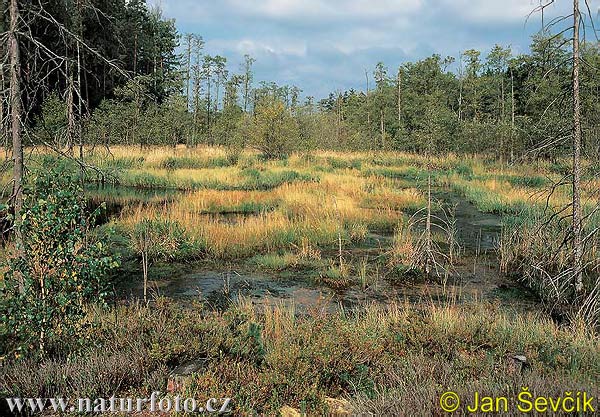
We've been talking about wetlands in class today, and I read this article the other day, so I thought I'd share it with you.
Global Warming Dries Up Peat Bogs
Take a look! MrE
Monday, October 20
Echo Hill Reflection
Tonight's homework:
Choose one picture or video on which to comment from the Echo Hill trip. Make sure to include a description of the setting (so we know which picture you're talking about), and a similar or contrasting experience that you had. Or talk about something that happened in that location; or talk about something you've done in your life that connects to that picture or video. Make sure to post your comment before the first bell rings for your class tomorrow--no posting in class. JE136
Choose one picture or video on which to comment from the Echo Hill trip. Make sure to include a description of the setting (so we know which picture you're talking about), and a similar or contrasting experience that you had. Or talk about something that happened in that location; or talk about something you've done in your life that connects to that picture or video. Make sure to post your comment before the first bell rings for your class tomorrow--no posting in class. JE136
Tuesday, October 14
Echo Hill Day Two
Hello Interweb,
Camp Life has been great lately. We've been seeing whitetail deer and all kinds of other animals, we've been canoeing, playing ball, and having a great time with our friends all over the campground. Here are some of my favorite photos.
When we're not lounging around and spending time on the water, we've been going on some some pretty serious adventures. The Echo Hill Staff has been working with us in setting group and individual goals. This morning some students did group exercises with Nate, the Director of Questions while others went with Scott and Erin to climb the Giant's Ladder, an individual challenge. I was lucky enough to participate in both. Here's some shots from the giants ladder and a video of one student riding down the zip line.
I was talking to Ms. Herrity and she said that every kid made it to their goal, or at least part of their goal. That's impressive! Students were encouraged to take on an extra challenge if they felt the climb might be too easy; there were routes that were more difficult than others, and some kids even chose to carry along an extra challenge like a rubber chicken.
The Echo Hill staff member that supervised the Ladder from the ground said that this was one of the most focused, positive, and socially aware groups that they've had come through this summer, and that everyone was looking out for everyone else the whole time.
What else can a teacher ask for?
Camp Life has been great lately. We've been seeing whitetail deer and all kinds of other animals, we've been canoeing, playing ball, and having a great time with our friends all over the campground. Here are some of my favorite photos.
When we're not lounging around and spending time on the water, we've been going on some some pretty serious adventures. The Echo Hill Staff has been working with us in setting group and individual goals. This morning some students did group exercises with Nate, the Director of Questions while others went with Scott and Erin to climb the Giant's Ladder, an individual challenge. I was lucky enough to participate in both. Here's some shots from the giants ladder and a video of one student riding down the zip line.
I was talking to Ms. Herrity and she said that every kid made it to their goal, or at least part of their goal. That's impressive! Students were encouraged to take on an extra challenge if they felt the climb might be too easy; there were routes that were more difficult than others, and some kids even chose to carry along an extra challenge like a rubber chicken.
The Echo Hill staff member that supervised the Ladder from the ground said that this was one of the most focused, positive, and socially aware groups that they've had come through this summer, and that everyone was looking out for everyone else the whole time.
What else can a teacher ask for?
Monday, October 13
Echo Hill Day One

Hi All,
Here are some pictures of our first day at Echo Hill. We had a nice ride up and then went about our business here at the school. My first class was Bay Studies. We took one of the vintage wooden skipjacks out on the bay and learned about all kinds of things -- fish features, bay history, adaptations, antique and current fishing methods, predator-prey interactions-- it was fantastic, Captain Carrington did a wonderful job.

We caught a 2 foot blue catfish that had been living in an old crab trap on the bottom; our cod net (now outlawed except by special educational permit) pulled up the trap, the catfish, and decaying catfish that the first cat was living off of.


A bit disgusting, but awesome nevertheless. We caught a Blue Crab (too small to eat), a bunch of white perch, a couple of pumpkinseeds and a couple of American eels.


Capt. Carrington and 1st Mate Molly told us the story of how all American eels travel to the Sargasso Sea to mate, and how the European eels make the same trip, but that the two species never interbreed.

What a day. I'm ready to crash. Too much learning.
Tuesday, October 7
Wednesday, October 1
The Molly Harris Garden

I know that Mr. Martire sent this around to the faculty earlier this week. It's hard to imagine just how much rain fell that day. Luckily we recently studied the water cycle, so this makes a great example of concentrated runoff.
Subscribe to:
Posts (Atom)